
How much space and power does an STP need?
Work out sewage first: residents times 150 litres a day, times 0.8. CPCB's 2013 averages then give about 0.55 square metres and 0.15 to 0.22 kWh a day per KLD for MBBR or SBR plants. Small building plants need more per KLD, so ask for a layout drawing and a motor load list.
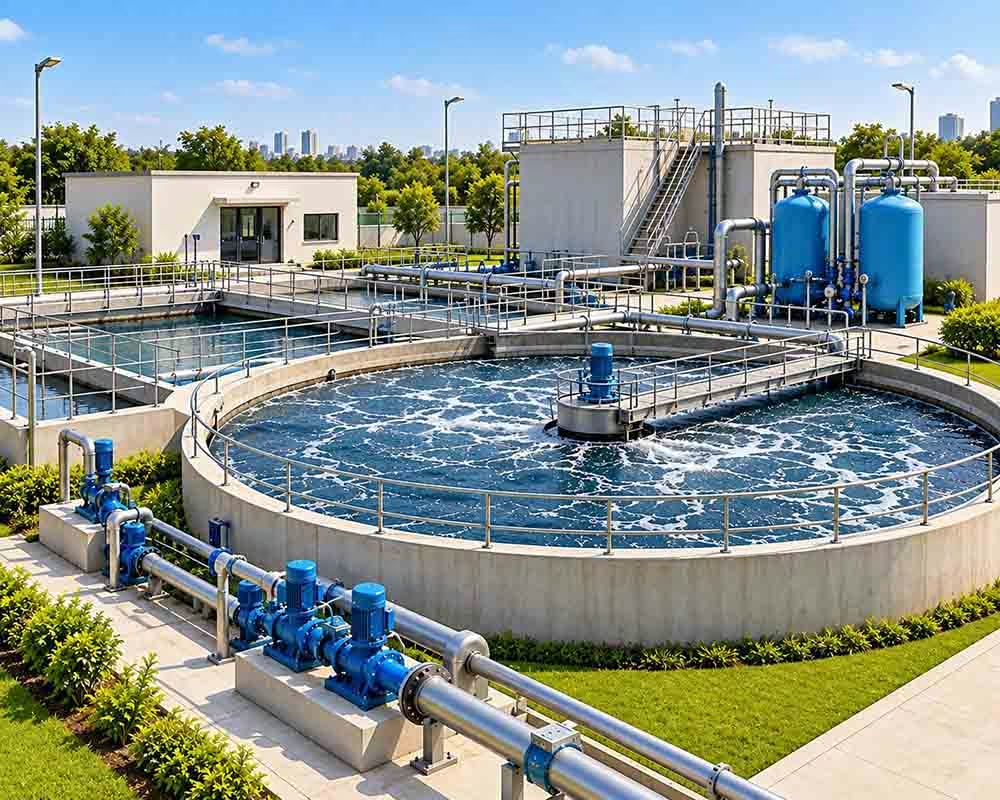
When a building manager calls about a new STP, the first two questions are nearly always the same. How much of the basement will it take, and what will it add to the electricity bill? Both answers come from one number, the plant capacity in KLD. So this guide starts there and then works out space and power for a real sized example.
It is written for societies, hotels, hospitals, offices, schools and factories across Delhi NCR. Every figure below comes from a government manual, a BIS standard or a CPCB study, named each time. Use them as typical ranges for planning, not as a design.
Start with the daily sewage flow in KLD
KLD means kilolitres per day, so 1 KLD is 1,000 litres a day. An STP is sized on how much sewage reaches it in a day, and that comes from how much water the building uses.
For homes, the CPHEEO Manual on Water Supply and Treatment recommends 150 litres per head per day for metropolitan cities with sewerage. IS 1172:1993 from BIS gives 150 to 200 litres per head per day for large cities with full flushing. For flats in Delhi NCR, 150 is the figure to start with.
Not all of that water becomes sewage. CPCB's 2013 report on STPs says almost 80 percent of domestic water supply comes back as wastewater. The CPHEEO sewerage manual puts the range at 40 percent in arid areas to 90 percent in well developed areas. For planning, take sewage as about 80 percent of the water figure.
Per-head figures for other buildings
For buildings other than flats, use the institutional figures in Table 3.4 of the CPHEEO Manual on Sewerage and Sewage Treatment Systems (2013). IS 1172:1993 gives the same numbers. The sewage column is simply 80 percent of the water column.
| Building type | Water, litres per day (CPHEEO / IS 1172) | Approx. sewage at 80% |
|---|---|---|
| Flats in a metro city | 150 per resident | 120 per resident |
| Hotel or lodging house | 180 per bed | 144 per bed |
| Hospital above 100 beds, laundry included | 450 per bed | 360 per bed |
| Hospital up to 100 beds, laundry included | 340 per bed | 272 per bed |
| Hostel, boarding school, nurses' quarters | 135 per head | 108 per head |
| Restaurant | 70 per seat | 56 per seat |
| Office | 45 per head | 36 per head |
| Day school or college | 45 per head | 36 per head |
| Factory staff, with bathrooms | 45 per head (30 without) | 36 per head (24 without) |
Sewage arrives in a morning rush and an evening rush. CPHEEO uses a peak factor of 3 for sewers serving up to 20,000 people. A building STP does not size every tank for that peak. It takes the peaks in an equalisation tank and feeds the plant at a steady rate, which is one reason the plant room is bigger than the treatment tanks alone.
Worked example: a 200-flat society
The household size and staff count here are assumptions for the example. Use the RWA's own register for your building.
- Residents: 200 flats at 5 people each gives 1,000 residents.
- Water: 1,000 residents at 150 litres is 1,50,000 litres a day, or 150 KLD.
- Staff: 30 guards, housekeeping and maintenance staff at 45 litres each adds 1,350 litres, about 1.4 KLD.
- Sewage: 80 percent of about 151.4 KLD is about 121 KLD.
- Design capacity: round up for visitors, the clubhouse and full occupancy. For this example we take 125 KLD. How much margin to add is a design decision, so ask your designer to show it in writing.
So this society needs an STP of roughly 125 KLD.
How much area an STP needs per KLD
The most useful public comparison is Table 6 of the CPCB report Performance Evaluation of Sewage Treatment Plants under NRCD (2013). It gives average area and daily power per MLD for common technologies, with sludge handling and tertiary treatment included. One MLD is 1,000 KLD, so we have divided by 1,000 to get per KLD figures and then multiplied by 125 for our example.
| Technology | Area, m² per KLD | Power, kWh per KLD per day | 125 KLD example |
|---|---|---|---|
| Activated sludge (ASP) | 1.0 | 0.19 | about 125 m², 23 kWh a day |
| MBBR | 0.55 | 0.22 | about 69 m², 28 kWh a day |
| SBR | 0.55 | 0.15 | about 69 m², 19 kWh a day |
| MBR | 0.45 | 0.30 | about 56 m², 38 kWh a day |
Treat these as a floor, not a quote. They are averages from large municipal plants. A city plant spreads its blower house, sludge handling and roads over thousands of KLD. A 125 KLD building plant still needs a panel, a standby blower and walking space around every tank, so its area and power per KLD will normally come out higher than the table.
The same CPCB table puts MBR's capital cost at nearly three times that of the others, so MBR saves space but costs more to build and run.
What takes up the space
- Bar screen and oil and grease trap at the inlet
- Equalisation tank for the morning and evening peaks
- Aeration tank (MBBR or SBR) with diffusers
- Settling tank or tube settler, which an SBR does not need as it settles in the same tank
- Sludge holding tank and a filter press or sludge drying arrangement
- Tertiary filters, disinfection and a treated water tank if you plan to reuse the water
- Blower room, pumps and the electrical panel, with room to service them
Reuse is worth planning from day one. IS 1172 counts 45 litres per head per day of the domestic figure as flushing. With dual plumbing, treated water from the STP can go back to flush tanks and gardens, which needs the tertiary stage and a separate tank.
Putting an STP in the basement
Land is tight, so many NCR towers put the STP under the podium or in the lowest basement. The CPHEEO sewerage manual itself says plants in metros will have to be built on less land and suggests multi-tier STPs. In a building that usually means deeper tanks rather than wider ones.
A basement plant room needs forced ventilation with the exhaust taken above the building, a hatch or ramp big enough for blowers and MBBR media, a clear route to take sludge out to a vehicle, a floor drain and sump, good lighting and enough headroom to lift a motor. Blowers are noisy, so keep the blower room away from walls shared with flats or offices. Check fire and building approvals with your authority before the layout is frozen.
How much power an STP uses
From the CPCB table, daily power runs from about 0.15 kWh per KLD for SBR to about 0.30 for MBR. For our 125 KLD society that is 19 to 38 units a day, or roughly 570 to 1,140 units in a 30-day month, before the small-plant effect described above.
Most of it is the aeration blowers. In the CPCB table, the treatment process itself accounts for 220 of the 223.7 kWh per MLD a day for MBBR. After the blowers come the transfer, filter feed, sludge and dosing pumps.
When you compare quotes, do not compare the connected load. A standby blower counts in the connected load but does not run. Ask each supplier for a load list with the kW rating, duty or standby, and running hours per day of every motor. Multiply kW by hours for duty motors only, add them up, and you have units per day you can check against your bill.
Power cuts and DG backup
The bacteria in an aerobic tank live on the air the blowers supply. If the blowers stop for long, the tank turns septic and the smell reaches the parking. Put the duty blower and the raw sewage transfer pump on DG supply. The equalisation tank holds the incoming sewage for a while, and the tertiary filters can wait until mains power returns.
Hotels, hospitals, offices, schools and factories
Hotels: a 200-bed hotel at 180 litres per bed uses 36 KLD for rooms, about 29 KLD as sewage. Add the restaurant at 70 litres per seat and staff. An in-house laundry adds a lot of load, so count it separately.
Hospitals: a 150-bed hospital at 450 litres per bed uses 67.5 KLD, about 54 KLD as sewage. Add staff quarters at 135 litres per head. Your bio-medical waste plan decides which liquid streams need pre-treatment before they reach the STP.
Offices: 1,000 staff at 45 litres each use 45 KLD, about 36 KLD as sewage. Flow comes in working hours and drops at weekends, so equalisation and blower control matter more than in a society.
Schools: day schools use 45 litres per head and boarding schools 135. The plant must survive long vacations with very little flow. Ask the supplier how they will keep the biology alive in May and June.
Factories: the 45 litre figure, or 30 without bathrooms, covers toilets and canteens only. Process wastewater goes to an ETP, not the STP. Our guide on STP vs ETP explains the split.
What to send us for a sizing check
- Building type and head count: flats and residents, beds, staff, seats or students
- Water meter readings, or monthly borewell and tanker figures, if you have them
- The proposed plant location with length, width, headroom and a few photos
- Available power, DG capacity and the hours it runs
- What you want to do with treated water: flushing, gardening or drain
Jaljiwan designs and installs STP plants for buildings across Delhi NCR and can check a layout or a supplier's load list before you sign. Send the details through our quote form, call +91-9312889634 or message us on WhatsApp. If your society is also looking at its fresh water, read our guide to water treatment plants for housing societies. For running an existing plant, see our AMC services.
Sources used in this guide
- CPCB, Performance Evaluation of Sewage Treatment Plants under NRCD, 2013, Table 6 and foreword
- CPHEEO, Manual on Sewerage and Sewage Treatment Systems, 2013, Part A, sections 3.5 and 5.3.5, Tables 3.2 and 3.4
- CPHEEO, Manual on Water Supply and Treatment, 1999, Table 2.1
- BIS, IS 1172:1993, Code of Basic Requirements for Water Supply, Drainage and Sanitation
Frequently asked questions
CPCB's 2013 study of sewage treatment plants gives average total areas, secondary plus tertiary treatment, of about 0.45 square metres per KLD for MBR, 0.55 for MBBR and SBR, and 1.0 for activated sludge. A small building plant needs more per KLD once access, panels and standby equipment are added, so ask for a layout drawing.
The same CPCB table puts average daily power at about 0.15 kWh per KLD for SBR, 0.19 for activated sludge, 0.22 for MBBR and 0.30 for MBR. For a real figure, ask the supplier for a load list with the kW and running hours of every duty motor.
Multiply the number of residents by the per-head water figure, then take about 80 percent of that as sewage. CPHEEO uses 150 litres per head per day for metro cities, so 1,000 residents use about 150 KLD of water and send about 120 KLD to the STP, before any design margin.
CPHEEO lists 450 litres per bed per day for hospitals above 100 beds and 340 litres per bed for smaller ones, laundry included. At 80 percent return, a 150-bed hospital sends about 54 KLD of sewage from the wards. Add staff quarters at 135 litres per head and any canteen load.
Yes, and many Delhi NCR towers do. The room needs forced ventilation with odour exhaust, a hatch for equipment, a route to take sludge out and enough headroom for blowers. Check approvals with your authority before the layout is frozen.
The aeration blowers and the raw sewage transfer pump should. The bacteria need air, and a long stop lets the tank turn septic and smell. Filters can wait for mains power.
Questions about this article? Contact Jaljiwan with your city and plant type.