What water treatment plant does a housing society need?
It depends on the water report for each source. A typical society plant filters out sand, iron and turbidity, softens the water if hardness is high, and uses RO only where TDS is high, often just for drinking and cooking. Size it from flats, source split and peak demand, and plan basement space and power backup.
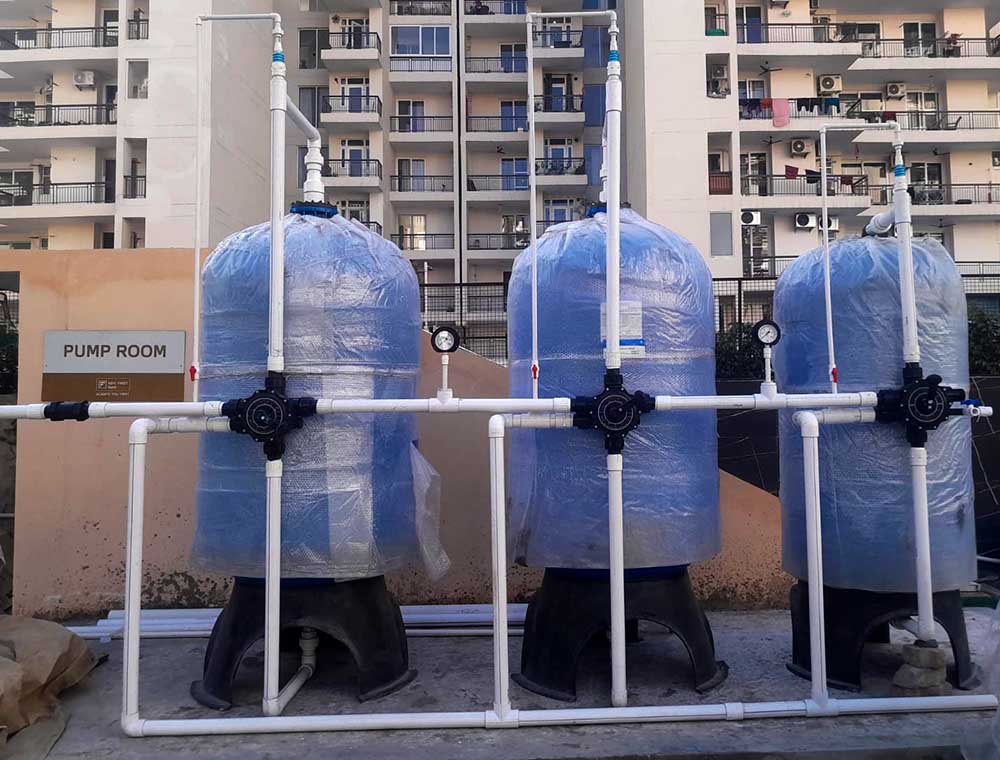
Most housing societies in Delhi NCR do not have one water source. They have three. A borewell that runs most of the day, a municipal line that comes for an hour or two, and water tankers in May and June when both fall short. All of it lands in the same underground tank, and residents then ask why the taps scale and why the kitchen RO needs service every few months.
A society water treatment plant is meant to fix that at the tank, before water goes up to the overhead tanks and into every flat. This guide is how we approach it at Jaljiwan when an RWA or a builder's facility team calls us. It is written for the committee member who has to sign the order, not for a process engineer.
Start with what goes into the underground tank
First find out where the water actually comes from and in what share. A society that gets 80 percent municipal water needs a very different plant from one that runs almost fully on borewell and tankers. Ask the maintenance supervisor for a rough split across a normal month and a summer month.
Borewell water and TDS
Borewell water in Delhi, Gurugram, Faridabad and parts of Noida is often hard and can carry high TDS, iron or turbidity. Two borewells on the same road can test very differently, so a neighbour's report is not a design basis. If the society has more than one borewell, test each one. Test again after the monsoon, as quality shifts through the year.
Tanker and municipal water
Tanker water is the hardest to plan for. Each load can come from a different source, and you rarely know which. Some loads are clear and low in TDS. Some are muddy or smell of iron. Treat tanker water as an unknown and design the filters for the worst load you are likely to get, not the best one.
Read the water report against IS 10500
Get a lab test of the underground tank and of each borewell separately. The Indian standard for drinking water, IS 10500:2012, gives an acceptable limit for each parameter and a higher permissible limit that applies only when there is no alternate source. A few of the lines a society report will usually show:
| Parameter (IS 10500:2012) | Acceptable limit | Permissible limit, no alternate source |
|---|---|---|
| Total dissolved solids (TDS) | 500 mg/l | 2,000 mg/l |
| Total hardness (as CaCO₃) | 200 mg/l | 600 mg/l |
| Iron (as Fe) | 0.3 mg/l | No relaxation |
| Fluoride (as F) | 1.0 mg/l | 1.5 mg/l |
| Nitrate (as NO₃) | 45 mg/l | No relaxation |
Source: IS 10500:2012 Drinking Water Specification (BIS, PDF hosted by CPCB). The standard covers many more parameters, including bacteria, so read the full report.
Is RO required for borewell water?
Not always. RO is the stage that brings TDS down. If the report shows TDS well within the acceptable limit and the problem is only turbidity, iron or hardness, filtration and softening may be all you need. If TDS is high, RO is usually the practical answer for drinking water.
The other mistake we see is RO placed straight on rusty or muddy water. The membranes foul within months and the society blames the brand. Iron, sand and colour have to come out first, which is what a WTP with pressure sand and carbon filters is for. If hardness is high, a water softener or antiscalant dosing protects the RO. Our hard water and softener guide covers that part in more detail.
Treat the whole supply, or only drinking water?
This is the decision that changes the budget the most, so settle it in the committee before you ask for quotes. Running RO on all the water a society uses means a large plant, a lot of reject water and a higher power bill, all to treat water that ends up in flushes and car washing.
A common approach is to filter and soften the full supply, so taps, geysers and washing machines stop scaling, and then run a separate RO for drinking and cooking water. That RO can feed a dedicated line or dispensing points. The plant is smaller and the reject volume stays manageable. Some societies prefer a central RO for the whole building anyway. That can work, but plan where the reject water goes before the order is placed.
A typical society treatment train
Every plant is drawn from the report, but most use the same few blocks:
- A feed pump from the underground tank, with dry-run protection.
- A pressure sand or multigrade filter for turbidity and suspended solids, with an iron removal stage if the report asks for it.
- An activated carbon filter for colour, odour and residual chlorine.
- A softener sized from hardness and peak flow, simplex or duplex depending on whether the supply can pause during regeneration.
- Cartridge filters and a commercial RO plant for the drinking water share, sized in LPH.
- Disinfection before water goes to storage, as the design specifies.
Where tanker water arrives muddy after rain, a UF system ahead of the RO keeps the feed steady. For sizing the RO itself, see how to choose RO plant capacity.
Plant room: basement space, drains and access
Most society plants sit in a basement corner near the underground tank, often next to the fire pump room and the STP. At the survey we measure the door width, the headroom under beams and the ramp, because a vessel that cannot pass the door is a problem no drawing will solve.
Check three more things in the basement. First, a floor drain that can take backwash water and RO reject without flooding the room. Second, ventilation, because a damp, closed room rusts panels and motors. Third, enough clear space in front of each vessel for media top-up and valve work.
Power cuts and storage
Power cuts are normal in many NCR sectors, and the plant has to live with them. Ask for low-pressure cut-off and auto flush on the RO, so it stops safely and flushes the membrane when power returns. Check that the panel restarts on its own after a cut and does not need someone to press a button.
Storage matters as much as plant size. If treated water storage is large enough to cover the morning and evening peaks, the plant can run steadily through the day and catch up after a cut. If the society has a DG set, decide which pumps and which plant stages run on it, and size the connection for that.
Running the plant after handover
A society plant is usually run by the maintenance team or the facility agency, not by a water engineer. Keep the daily routine simple: read the pressure gauges, check the product TDS, backwash the filters on schedule and watch the salt level in the brine tank. Write these in a register.
Cartridge filters are the cheapest part of the plant and the one most often skipped. Change them on time, and sooner after the monsoon or a run of dirty tankers. Our RO membrane maintenance tips explain what to log. If the committee would rather not manage this, an AMC with scheduled visits and listed spare parts takes it off their hands. Sewage is a separate plant. If your society is also looking at an STP, read STP vs ETP first.
What to send before you ask for a quote
Send us the number of flats and towers, the source split between borewell, municipal and tanker water, a recent water report for each source, photos of the basement plant room with the door, and your choice between treating the full supply or only drinking water. With that we can suggest a treatment train and plant size, and tell you what we still need to check on site.
Call +91-9312889634 or WhatsApp on the same number, or send the details through the request a quote page.
Frequently asked questions
IS 10500:2012 sets 500 mg/l as the acceptable limit for TDS. Up to 2,000 mg/l is permitted only when there is no alternate source. TDS is one line of the report, so check hardness, iron, fluoride, nitrate and bacteria as well before choosing a plant.
It can, but RO on the full supply means a bigger plant, more reject water and a higher power bill. Many societies filter and soften all the water and run a smaller RO only for drinking and cooking. Decide this in the committee before you ask for quotes.
Tanker loads change from one supply to the next, so size the filters for the worst load you expect, not the best. Test a few loads over a summer. Muddy loads after rain are where a UF stage ahead of the RO earns its place.
Questions about this article? Contact Jaljiwan with your city and plant type.